


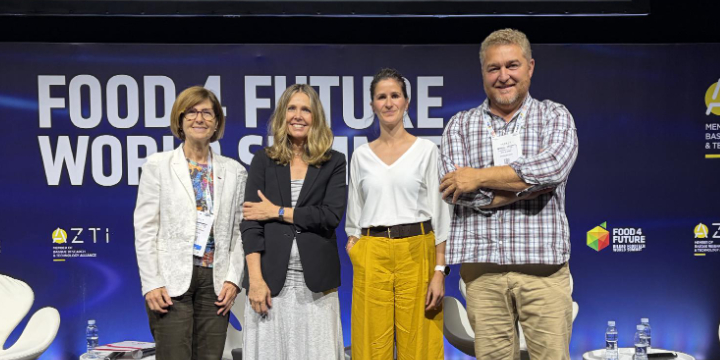
The Association hosted a panel discussion at Food4Future focused on its Mycowine project, highlighting how soil microbiology can increase the soil's water retention capacity by up to 30%.
BILBAO. FRIDAY, MAY 29, 2026
The Food Industry Association of Castile and León (Vitartis) is supporting the shift in mindset currently transforming viticulture, where soil is increasingly viewed as a living ecosystem because of its influence on wine quality. This was the key message of the panel discussion hosted by the Association at Food4Future 2026 (Bilbao), entitled "Microbiological Innovation in Vineyards for a Sustainable Future."
The discussion was moderated by Cristina Ramírez de Lara, Managing Director of Vitartis, and focused on how soil microbiology can become a key tool for improving vineyard sustainability and resilience in the face of climate change.
The panel featured Eva Navascués, R&D Technical Director at Alma Carraovejas; Silvia Burruezo, Winemaker at Bodegas Fariña; and Eloy Álvarez, Head of Viticulture at Bodegas Yllera.
The three winery representatives shared their experience as participants in the Mycowine project, led by Vitartis, which focuses on the use of indigenous microorganisms—that is, microorganisms that naturally exist in each vineyard plot and are already adapted to its specific soil, climate and grape variety conditions.
In this context, all three speakers agreed that viticulture is undergoing a profound change in approach. Whereas traditional vineyard management focused primarily on the vine and chemical treatments, attention is now shifting to the soil as a living ecosystem because of its significant influence on wine quality.
Climate change
"The importance of the soil's biological condition and its ability to support plants that are more resilient to water stress, extreme temperatures, and other effects of climate change has driven this shift," said Cristina Ramírez de Lara, Managing Director of Vitartis.
The discussion highlighted that soil microbiology can increase the soil's water retention capacity by up to 30%. The use of native mycorrhizal fungi and indigenous bacteria to regenerate soils and improve both plant health and wine quality has shown that "better results are achieved than with commercial solutions, while also improving water and nutrient availability for the vine," explained Ramírez de Lara.
 From left to right: Cristina Ramírez, Managing Director of Vitartis; Silvia Burruezo, Winemaker at Bodegas Fariña; Eva Navascués, R&D Technical Director at Alma Carraovejas; and Eloy Álvarez, Head of Viticulture at Bodegas Yllera.
Mycowine project
The Mycowine project aims to provide innovative solutions for the wine sector while generating a positive long-term impact. The technical research is led by Applied Forest Biotechnology (IDForest), with the participation of Bodega Matarromera, Bodegas Bilbaínas, Bodegas Fariña, Pago de Carraovejas, Real Sitio de Ventosilla, and Yllera Bodegas y Viñedos.
The initiative is funded by the Spanish Ministry of Agriculture, Fisheries and Food and the European Agricultural Fund for Rural Development (EAFRD), with total funding of nearly €600,000.